
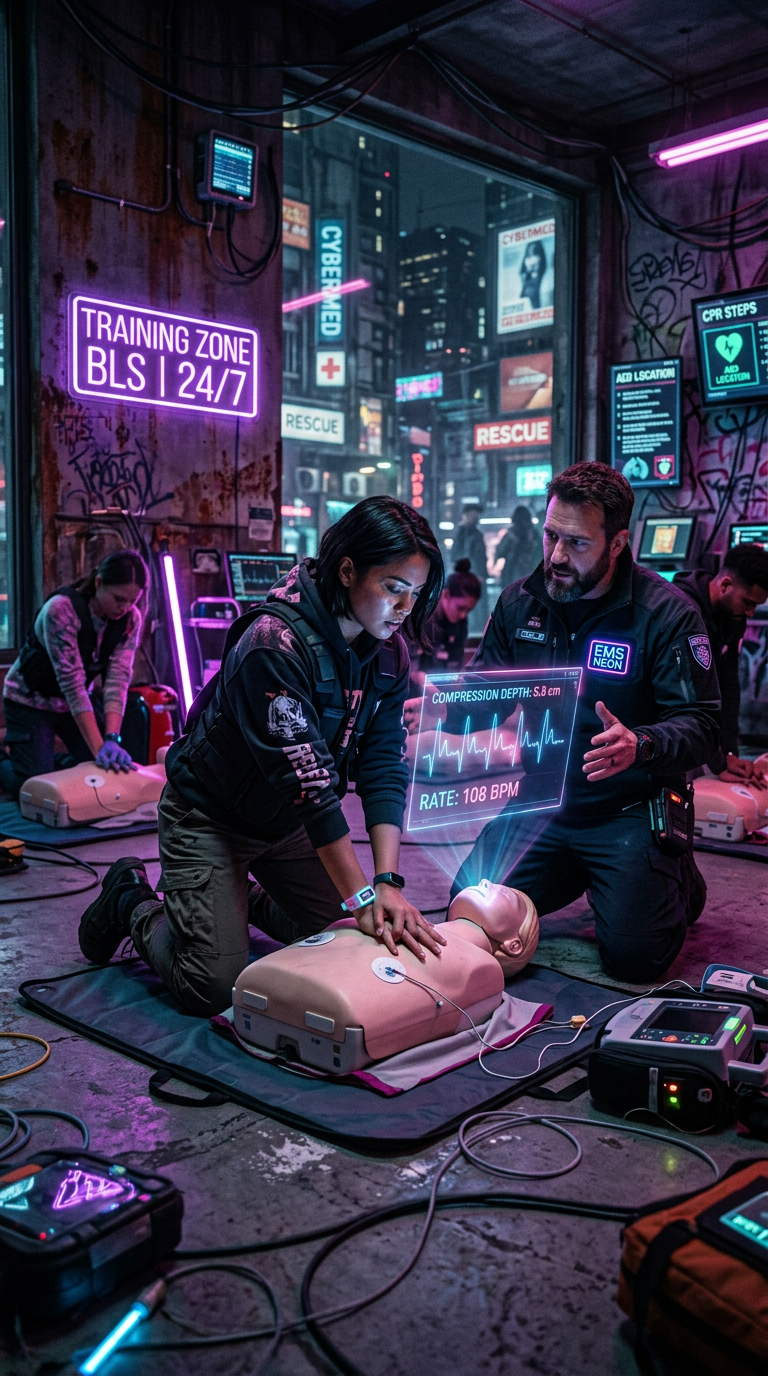
How to save a life? Do you want to learn? It is simple and anyone can start by simple measure.
Follow AHA guidelines or local CPR guidelines
Basic Life Support (BLS) is a foundational level of emergency medical care used to sustain life during life-threatening emergencies such as cardiac arrest, respiratory distress, and choking. It focuses on prompt scene assessment, calling for help, performing high-quality CPR, and early defibrillation.
The Core Steps (D-R-A-B-C or D-R-S-A-B-C)
BLS generally follows a systematic approach often remembered using standardized acronyms (such as DRSABCD or D-R-A-B-C):
- Danger: Ensure the scene is safe for both you and the victim.
- Response: Check for responsiveness by tapping the person’s shoulders and asking loudly, “Are you okay?”
- Send for Help (or Activate EMS): Call emergency services and get an AED (Automated External Defibrillator) immediately.
- Airway: Check if the airway is clear and open it (e.g., using the head-tilt/chin-lift method).
- Breathing: Look, listen, and feel for normal breathing for no more than 10 seconds.
- CPR/Circulation: If the person is unresponsive and not breathing normally, begin CPR. For adults, this involves firm chest compressions and rescue breaths at a ratio of 30 compressions to 2 breaths.
- Defibrillation: Attach and use an AED as soon as one arrives, following the device’s spoken voice prompts.
Who Needs BLS?
- Healthcare Providers: Doctors, nurses, paramedics, and first responders rely on BLS as a baseline.
- Laypersons and the Public: Public safety professionals, teachers, lifeguards, and general community members.
- Workplaces and Hospitality: In many regions (including resort and tourist sectors), BLS and first-aid compliance are strict regulatory requirements to ensure a safe environment.
Training and Certification
BLS courses are taught by authorized organizations through in-person, hands-on, or blended learning methods (combining online modules with practical assessments). To get certified, find localized training and certification programs from major organizations:
- American Red Cross: Offers a comprehensive portfolio of BLS courses and basic life-saving certifications.
- American Heart Association (AHA): Provides globally recognized BLS for healthcare professionals.
Leave a Reply